
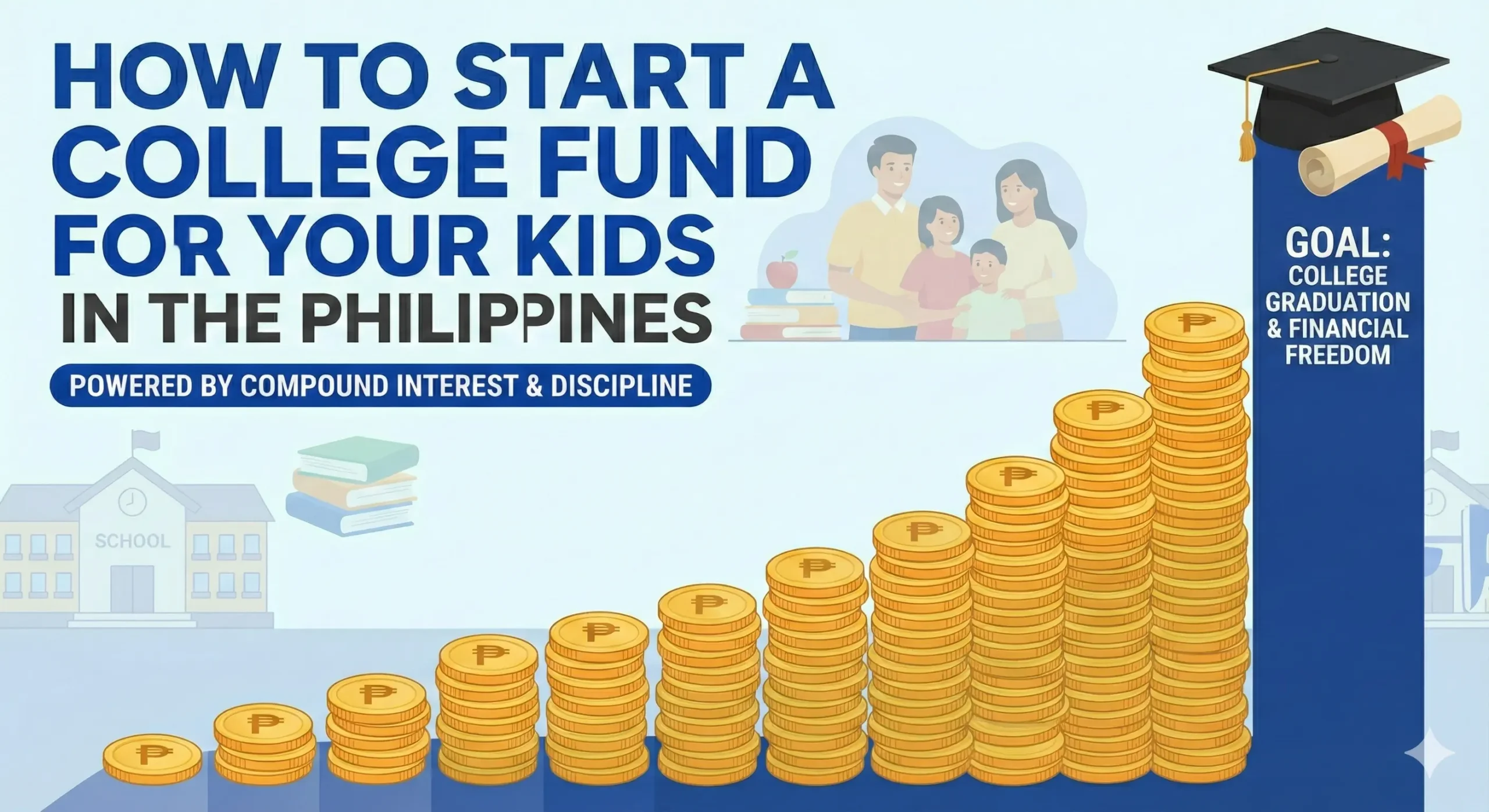
As a mom, I often find myself thinking about the future, not just about what’s for dinner tomorrow, but the bigger picture. One of the biggest milestones my children will face is college. With my eldest just six years away from entering university, the reality of tuition fees, allowances, and all the extras is slowly sinking in.
Another reality is that tuition fees in the Philippines keep climbing every year. As a finance professional, I know that if I don’t prepare now, we’ll feel the weight of those costs later on and planning ahead is the only way to make this manageable without stress.
So, let me share both my research and my personal approach to starting a college fund for my kids.
The Reality of Tuition Costs Today
To make smart plans, I started by looking at the actual tuition fees in some of the top private universities in the Philippines:
- De La Salle University (DLSU Manila): Around ₱200,000 to ₱225,000+ per year, because of its trimester system. Certain programs with labs and extra fees can push costs even higher.
- Ateneo de Manila University (ADMU): Roughly ₱160,000 to ₱200,000 per year for many undergraduate programs.
- University of Santo Tomas (UST): About ₱100,000 to ₱120,000 per year, depending on the course (with programs like nursing or engineering on the higher side).
- University of Asia and the Pacific (UA&P): Around ₱184,000 to ₱202,000+ per year.
- De La Salle–College of Saint Benilde (CSB): Between ₱195,000 to ₱300,000+ per year, depending on the program.
When I saw these numbers, it hit me: if my child studies at DLSU or Ateneo, I need to prepare at least ₱200,000 per year in today’s money. Multiply that by four years, and that’s almost a ₱1 million investment for just one child.
Tuition Fee Increase
Another mom concern? Tuition inflation.
Schools increase fees almost every year. Based on data from the Commission on Higher Education (CHED) and news reports, private universities in the Philippines raise tuition by about 5% to 10% annually. For example:
- CHED approved a 6.96% average tuition increase in AY 2017–2018.
- In some years, tuition hikes reached 8% or more.
- During the pandemic years, some private schools still raised fees, with one year hitting an average of 12% nationwide.
So, what does that mean for us parents? If tuition at DLSU is ₱220,000 now, in six years it could look like this:
- 5% increase/year: ₱295,000/year
- 7% increase/year: ₱330,000/year
- 10% increase/year: ₱390,000/year
That’s just tuition and school fees. We still need to add allowances, books, gadgets, transportation, and living expenses, which could easily add another ₱100,000 or more annually.
How to Build a College Fund
Now that we know the numbers, how do we prepare? Here’s how I’ve approached it as both a mom and a finance expert:
1. Set a Clear Target
I started by estimating how much my child’s chosen school might cost in six years. For example, if I assume ₱330,000/year at a private university, then I multiply that by four years. That’s about ₱1.3 million for four years. Hopefully my son will pass every subject!
2. Choose the Right Savings and Investment Tools for Your Child’s College Fund
As moms, we want the money we save for our kids to grow enough to keep up with tuition increases. The challenge is that not all financial tools give the same returns. Some are very safe (but grow slowly), while others carry risk (but can grow much faster).
Here’s a breakdown of the most common options we parents can use in the Philippines, along with examples of how each would look if we’re saving for ₱1.3 million in 6 years.
1. Savings Account
A savings account is the simplest and most common way to set money aside, and it is available at any bank. It is safe, accessible, and very easy to open, which makes it a convenient option for many families. However, the main drawback is that savings accounts earn very little, typically only around 0.10% to 0.25% interest per year. This means that while your money is secure, it will not grow enough to keep up with rising tuition fees and inflation.
Example:
If you put ₱10,000 every month in a savings account at 0.10% annual interest:
FutureValue: ₱10,000×72months=₱720,000
So after 6 years, you only get around ₱720,000, far short of the ₱1.3M target.
For me this is not the best option, the earning is too low and we only have 6 years to save but if you are really conservative and afraid of risks then you can stick with this but you have to add more amount to achieve your goal.
To reach ₱1.3 million in 6 years using only a savings account with 0.10% annual interest, you would need to save about ₱18,000 per month.
2. Time Deposit
A time deposit is a fixed-term savings product that offers guaranteed interest, usually around 1% to 2% per year. It is more secure than most investments and provides slightly better returns compared to a regular savings account.
However, the growth it offers is still too low to keep pace with the rising cost of tuition, making it a limited option if the goal is to fund a child’s college education in the future.
Example:
₱10,000 per month in a time deposit at 2% per year:
FutureValue≈₱10,000×72×(1.02)0.5≈₱750,000
If you choose this option you’ll end up around ₱750,000–₱770,000, which is still only half of what you need.
3. Mutual Funds or UITFs (Unit Investment Trust Funds)
Mutual funds and UITFs are pooled investment vehicles managed by professionals, making them accessible even to individuals without much investing experience. Equity funds, which are invested mainly in stocks, are generally recommended for long-term goals of six years or more because they offer higher growth potential. On the other hand, balanced or bond funds are considered lower risk, though they typically provide more modest returns. Historically, equity funds in the Philippines have delivered average annual returns of around 6% to 10%, although these are not guaranteed since market performance can fluctuate.
Example:
₱10,000 monthly in an equity fund at 8% annual growth:
FutureValue≈₱10,000×(1+0.08/12)72−10.08/12≈₱880,000
This will grow to around ₱870,000–₱900,000.
If you increase to ₱15,000 monthly the FutureValue is equal to ₱1.3M+
So saving at least ₱15,000 using this method is enough to meet the target!
This is actually one of my personal choices for long-term saving because it balances growth with manageable risk.
4. PAGIBIG MP2
Pag-IBIG MP2 (Modified Pag-IBIG II) is a voluntary savings scheme under Pag-IBIG Fund that offers higher dividend returns compared to the regular Pag-IBIG savings. It has a 5-year maturity period. After 5 years, you can withdraw the full amount (principal + dividends) or re-enroll and continue saving.
Because it is government-backed and offers a relatively attractive return with low risk, I consider MP2 a very solid “middle ground” tool in a college fund strategy.
For 2024, Pag-IBIG declared a dividend rate of 7.10% per annum for MP2. This is one of the highest rates for MP2.
Because MP2’s dividend is adjusted yearly depending on the fund’s performance, the rate could vary in future years, but using 7.10% as an assumption is reasonable given recent performance.
Example:
Because MP2 has a 5-year maturity, if you start today and deposit monthly for 6 years, you will likely go through one full MP2 cycle (5 years), then re-enroll for another 1 year (or part) in the next cycle. For simplicity, assume we treat it as if it compounds (i.e. you re-enroll or keep dividends rolling) at ~7.10% per year.
Here’s a sample projection:
| Monthly deposit (P) | Future Value after 6 years | Comments |
| ₱10,000 | ≈ ₱10,000 × [(1.005917)^72 – 1] / 0.005917 ≈ ₱864,000 – ₱880,000 | This is below target. |
| ₱15,000 | ≈ ₱1,296,000 – ₱1,320,000 | Close to the ₱1.3M goal. |
| ₱18,000 | ≈ ₱1,555,000+ | Exceeds the goal (gives a buffer). |
So to reach ~₱1,300,000 in 6 years with MP2 alone (at 7.10%), you’d likely need to deposit about ₱15,000/month.
But this is a simplification, because MP2 cycles are 5 years and dividend rates may shift. Also, the first 5 years you get full MP2 benefit; the 6th year might be another cycle or reinvestment. But as a planning estimate, this is useful.
5. Stocks (Direct Investing)
Investing directly in stocks means buying individual company shares through the stock market. This approach has the potential to generate higher returns compared to mutual funds since you can benefit directly from the growth of specific companies. However, it also carries much greater risk, especially if you do not actively monitor your investments.
Without proper knowledge and discipline, the value of your portfolio can fluctuate significantly, making direct stock investing a less suitable option for parents who prefer a more hands-off approach.
Example:
If you buy ₱10,000 worth of top-performing stocks monthly and average 10% annual returns:
FutureValue≈₱950,000–₱1,000,000
With luck and discipline, you can reach ₱1.3M by adding ₱12k–₱13k monthly.
This option is great for those who understand investing. But as a busy mom, I personally prefer mutual funds/UITFs (managed by professionals) instead of actively trading myself.
6. Mixed strategy (MP2 + Mutual Funds / UITFs + Safe port)
Because as a mom I don’t want all eggs in one basket, here’s how I might mix:
- Put, say, ₱8,000/month in MP2 (expected ~7.10%)
- Put ₱7,000/month in an equity mutual fund (target return ~8.0%)
- Keep a buffer (emergency / safe money) in savings/time deposit
Let’s see approximate values after 6 years:
MP2 portion (₱8,000 / mo):
Future value at 7.10% ~ ₱8,000 × factor ≈ ₱8,000 × ~86.4 = ₱691,200
Equity mutual fund portion (₱7,000 / mo at assumed 8.0%):
Using the same formula with monthly return = 8% / 12 = 0.6667%:
FV ≈ ₱7,000 × [(1.006667)^72 – 1] / 0.006667 ≈ ₱7,000 × ~84.5 = ₱591,500
Total from both portions ≈ ₱691,200 + ₱591,500 = ₱1,282,700
Add some buffer or safe margin → you might reach ₱1.3M or more.
This mix gives some diversification: you benefit from MP2’s reliable rates plus potential higher growth via mutual funds.
3. Automate the Saving Habit
Life gets busy. To make sure I don’t skip, I’ve automated transfers to my kids’ college fund every month. It feels just like paying tuition early except the money grows while waiting.
4. Revisit Every Year
Every year, I check two things:
- How much schools are increasing tuition.
- Whether my savings and investments are on track.
If I get bonuses or extra income, I allocate a portion to the fund. I think of it as a gift to my kids’ future.
Conclusion
As moms, we want to give our kids the best education possible, but the numbers can feel overwhelming. The good news is, if we start now, we can get there without the stress.
For me, knowing that tuition could climb to ₱300,000 to ₱400,000/year in six years makes it clear: saving a little here and there won’t cut it. I need a focused plan. And the earlier we start, the less painful it will be.
At the end of the day, a college fund isn’t just about money. It’s about giving our children the freedom to choose their future, without worrying about the financial burden. And for me as a mom, that peace of mind is priceless.
So my personal advice is clear: build your child’s college fund like you would build their future with discipline, patience, and the right strategy. You can always combine some of the strategies above to be able to achieve your goal.